Alan Pangborn
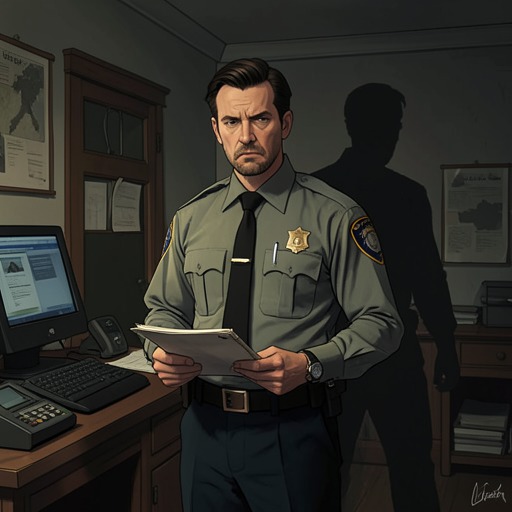
The Dark HalfAlan Pangborn is the sheriff of Castle Rock and the investigating officer whose pursuit of the person behind Homer Gamache’s murder brings him into the Beaumont family’s struggle with George Stark. He begins by treating the case as a problem of evidence and plausible explanation; as the evidence accumulates, his concern for the victims outlasts his skepticism. At the final confrontation, he risks his life to protect Liz and the twins, and emerges with a direct knowledge of the supernatural force he had been trying to explain away.
Identity and investigative approach
Pangborn’s investigation joins a local murder to a widening pattern of violence. He is not satisfied with solving the case as an abstract puzzle: even under pressure from New York City’s police commissioner and the prospect of becoming a media figure, he tells Thad that Homer matters to him more than the two officers killed while protecting Phyllis Myers. His concern gives the inquiry a personal and ethical center amid competing jurisdictions and mounting public attention.
The physical evidence initially seems to point toward Thad. Pangborn explains that Homer’s pickup was found at a Connecticut rest stop near the New York border, with the killer’s fingerprints among the prints inside. One impression, he says, was exceptionally clear: it had been left in gum stuck to the dashboard, while the best print was on the rearview mirror, rolled in blood. The precision and circumstances of the prints make them difficult to dismiss, but do not by themselves settle who committed the murders.
Thad challenges the implications of the fingerprint evidence by asking how many comparison points are needed before a print can be admitted and suggesting that the prints’ very quality deserves scrutiny. He draws on research for the Stark novels, while acknowledging that he had treated such technical details as material to invent rather than a subject to master. The exchange exposes the distance between evidence as a physical trace and the story investigators construct around it: the prints are real, but the explanation attached to them remains open to question.
From suspicion to a widening case
When Thad insists that he knows who Pangborn is and refuses to go anywhere without an explanation, the sheriff is confronted not only by a suspect’s resistance but by the strange scale of the accusation. Thad sarcastically reconstructs a theory involving an identical twin: one brother could remain in Castle Rock, murder Homer, and take Thad’s appointments, while Thad drove Homer’s truck to Connecticut, changed cars, traveled to Washington, and killed Frederick Clawson before returning to Ludlow. The invented-seeming double itinerary—and the possibility that Liz was involved—makes visible the extraordinary explanation that the evidence appears to demand.
Pangborn’s questions turn toward why Homer was killed. He notes that a witness thought Homer had been beginning to cross the road, or was close to doing so, when Homer’s pickup approached. Yet Thad’s connection to Clawson in Washington makes it increasingly likely that Homer was targeted for who he was, rather than simply killed because he was drunk and had stopped. Pangborn therefore asks Thad to explain Clawson, shifting the investigation from the circumstances of a roadside encounter to the relationships linking the victims.
That line of inquiry does not immediately resolve the motive. After listening to Thad and Liz, Pangborn sits with the question of why anyone would resort to murder over the secret at issue, especially after it had already become public. The question marks a limit in the case’s first explanatory framework: disclosure alone cannot account for the killings, and the connection between the exposed identity and the violence remains central to understanding what is happening.
Testing the Stark explanation
The case expands beyond Homer and Clawson. Pangborn is told that two officers protecting Phyllis Myers have also been killed, and he presses Thad for the name of the man he believes is responsible. The demand is sharpened by the costs of uncertainty: there are now additional victims, officials are pressing for answers, and the sheriff is answerable both to the investigation and to the people who have died.
Evidence of a telephone call briefly seems to provide a different solution. Pangborn returns to the matter after hearing that an explosion has taken place at Rick Cowley’s apartment: he had been less than three miles down the road toward Orono when the report came over the radio, and immediately turned back. Later, after an assumption in the investigation proves wrong, Thad advises him to think again about George Stark. Pangborn’s willingness to revisit the case reflects a detective’s obligation to revise a conclusion when events contradict it, even when the replacement explanation is difficult to accept.
The voice-print results arrive shortly after eight o’clock and are described as astonishing. Their arrival gives the investigation a new evidentiary development, following an interval in which Dr. Pritchard has not called back. The supplied account does not detail the comparisons or their technical result, but the voice prints become part of the accumulating evidence that makes Pangborn reconsider the identity of the caller and the significance of Stark.
Pangborn also receives information about Thad’s medical examination: after Thad’s consent, Dr. Hume in Orono tells him that the neurological tests are negative. This does not by itself prove a supernatural explanation, but it removes one possible medical account from the sheriff’s deliberations. Pangborn’s mind turns in the same moment to Dr. Hugh Pritchard, who operated on Thad when he was eleven, bringing Thad’s childhood surgery back into the investigation as a possible clue rather than a settled answer.
Doubt, decision, and capture
Even as Pangborn pursues the case, he resists treating uncanny claims as proof. After hearing what Fuzzy Martin has seen, he believes the report while telling himself that it proves nothing—not, at least, that anything supernatural is happening. He privately considers Thad’s apparent madness as a possible explanation, yet recognizes that dismissing the strange evidence is also an assumption. The tension between belief and professional caution is not simply a delay: it shows the investigator trying to preserve standards of proof when the available facts strain them.
A later call sends Pangborn back toward the heart of the crisis. It comes just after three o’clock, while Thad is at an Augusta service station pouring three quarts of Sapphire Motor Oil into Rawlie DeLesseps’s Volkswagen; Pangborn himself is on his way to get coffee at Nan’s. The ordinary errands around the call underline how abruptly the investigation returns to danger. Pangborn eventually calculates a possible sequence in which Stark switched cars and went to his Ludlow home around twelve-thirty, though he presents that timing as a reconstruction rather than a confirmed fact.
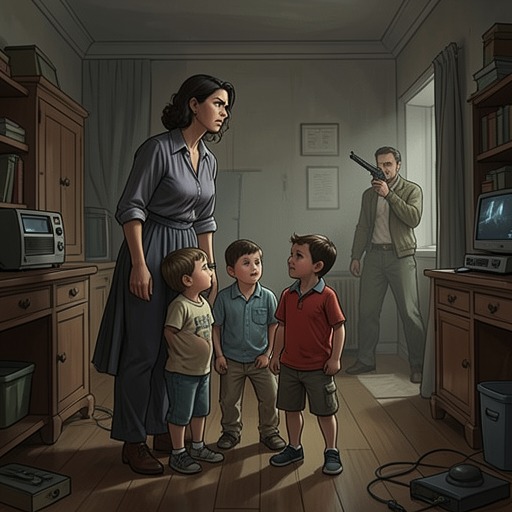
At the Beaumonts’ property, Pangborn chooses to enter alone. He reasons that calling for backup before understanding the situation might cause the deaths of a woman and two infants; he would rather bear the possibility that he had acted foolishly than risk making that call too soon. His decision places the protection of Liz and the twins above procedure, while making clear that the decision is his own and may be wrong.
The solitary approach ends with Stark catching him. As Pangborn moves down toward the Beaumonts’ driveway, Stark puts a gun to his ear and threatens him if he moves. Captured and kept under Stark’s control, Pangborn has to conceal his position and comply while the danger continues. During this period, Stark’s smell is making him feel close to gagging, but Pangborn tries not to let it show in his voice; he asks dispatch whether Norris Ridgewick has returned and, after hanging up, turns to Stark for confirmation. His composure is tactical rather than evidence that he has control of the situation.
The sparrows and the end of the crisis
Pangborn’s caution about the supernatural is overturned by what happens in the living room. When a wall of twenty thousand sparrows bursts through the window, he sprints across the room and tackles Liz just as the window gives way; more vast groups follow until the birds fill the room. The scale and directness of the event leave no room for his earlier strategy of treating reports as unverified. He acts first to protect Liz, in a scene where the evidence arrives not as a statement or a print but as an overwhelming physical presence.
Afterward, the people present have witnessed enough to understand that the crisis has ended. Pangborn and Liz both know what has happened, in contrast to the uncertainty that had governed his investigation. When Thad asks how long it will take before someone becomes suspicious and checks the place, Pangborn is standing in the doorway with Liz and is asked for an honest, accurate estimate. His role has shifted from interrogator to ally in the family’s immediate effort to manage the aftermath.
Pangborn’s final response refuses any further pretense that the important question is whether the events can be explained away. He tells Thad that he does not care about anything except that it is over. The blunt relief closes the progression from evidence-led doubt to firsthand knowledge: the sheriff has not abandoned reason so much as reached the point at which the facts he has witnessed demand a different understanding. His concern for Homer and the other victims, and his choice to risk himself for Liz and the twins, remain the human measure of that change.